
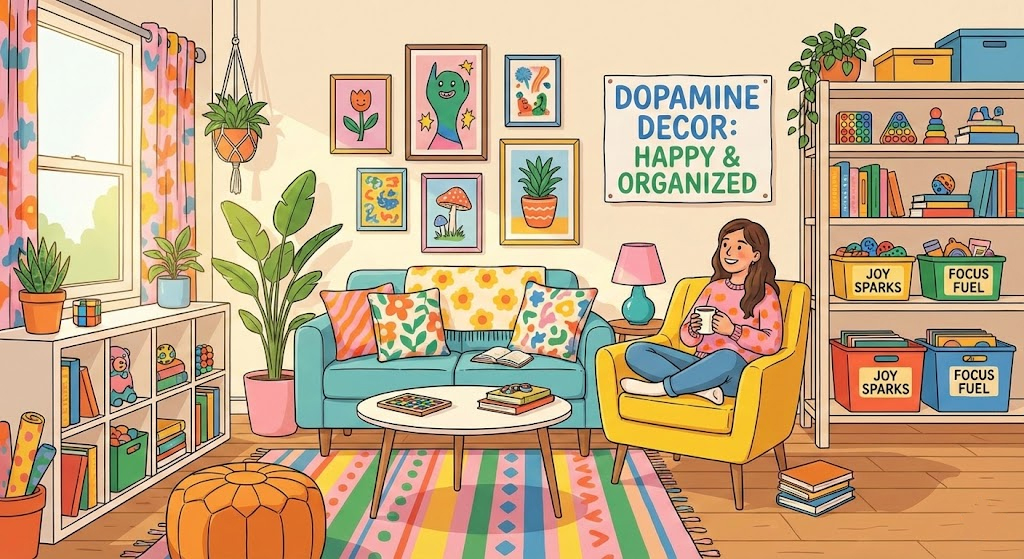
Dopamine Decor: How to Style Your Home for an ADHD Brain (Without It Looking Like a Yard Sale)
If you look at “aesthetic” home decor on Instagram right now, you’ll see a lot of… beige.
Sad beige sofas. Cream-colored rugs. White walls. Minimalist shelves with one (1) singular succulent on them.
For a neurotypical brain, this is probably calming.
For an ADHD brain? It is a padded cell of boredom.
Our brains run on dopamine—the reward chemical. We crave visual interest, color, and stimulation. When we don’t get it, we get bored. And when we get bored, we start doing things like “reorganizing the pantry at 3 AM” or “starting a new hobby that requires $400 of supplies.”
Enter: Dopamine Decor.
It’s not just a TikTok trend; it’s actually a valid way to hack your environment to make your brain happier. Here is how to create a space that celebrates your neurodivergence instead of trying to hide it.
1. “Live, Laugh, Love” is Banned
We don’t do generic here.
If you hang art on your walls, it needs to actually mean something to you. If your eyes glaze over when you look at it, it’s just visual clutter.
ADHD brains love high-contrast, vivid imagery. That’s why we designed our Art Print Collection with that gritty, street-art aesthetic.
- Take our “Power of Focus” print. It’s mostly grey (the noise of the world), but the center is exploding with technicolor (your hyperfocus).
- It’s not just a pretty picture; it’s a visual reminder of how your brain works. When you look up from your desk, you don’t need a picture of a sunset; you need a reminder that your ability to deep-dive is a superpower.
2. Embrace the “Visual Cues” (aka: Don’t Hide Your Stuff)
The biggest lie neurotypicals told us is that “clean” means “empty surfaces.”
For us, Object Permanence is a real struggle. If I put my keys in a drawer, they cease to exist in this dimension. They are gone.
- The Hack: Stop trying to hide everything. Use open shelving, clear bins, and pegboards.
- The Vibe: Turn your clutter into a collection. Got 15 Rubik’s cubes? Don’t stuff them in a box. Line them up on a shelf by color. Now it’s “Decor,” not “Hoarding.”
3. Lighting is Everything (Death to the Big Light)
We have talked about this before (shout out to the Fluorescent Lighting Villain Mug crew), but overhead lighting is the enemy of dopamine. It’s aggressive. It makes you feel like you’re being interrogated.
- The Fix: Lamps. Fairy lights. LED strips behind your monitor.
- Why: Softer, colored lighting reduces sensory strain and makes a room feel like a safe “nest” rather than a waiting room.
4. Create a “Rot Corner”
Sometimes, the executive dysfunction wins. You can’t clean, you can’t work, and you can’t perceive. You just need to… rot.
Designate a specific spot for this. A beanbag, a hammock, or just a pile of pillows in the corner.
Surround this spot with things that make you happy—texture is key here. Plushies, a weighted blanket, and art that makes you smile.
Our “Neurodivergent Vision” print is perfect for this spot. It shows a kid finding a rainbow dandelion growing out of a crack in the pavement. It’s a quiet reminder that even when things feel grey and gritty, you have the ability to find the magic in the details.
The Bottom Line
Your home doesn’t need to look like a magazine catalog. It needs to look like you.
If that means painting a wall electric blue, hanging a poster of a kid unlocking a rainbow door, and having a dedicated basket for your fidget toys—do it.
Stop decorating for the guest you might have over twice a year, and start decorating for the brain that lives there 24/7.
Need some wall candy?
🎨 Shop our Digital Art Downloads here. (Instant dopamine: Buy it, download it, print it today!)