
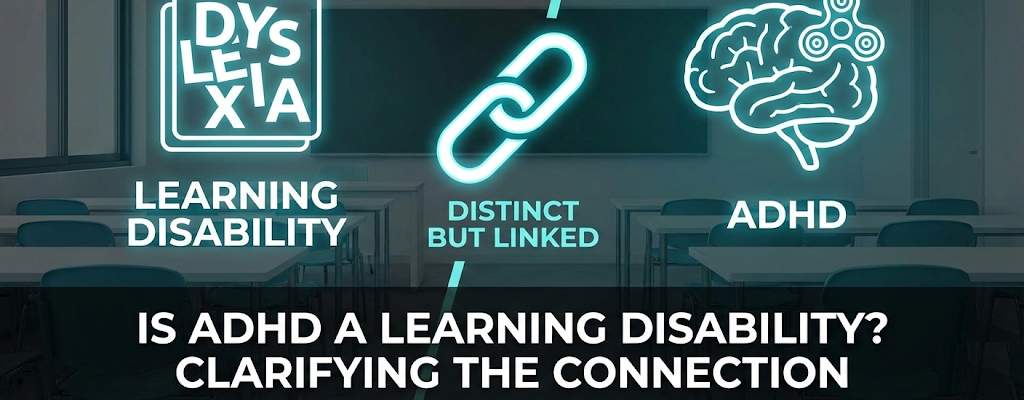
The Label Confusion: Is ADHD a Learning Disability?
If you have a child who is failing math, forgetting homework, and struggling to read a full chapter, it certainly feels like a learning disability.
But if you look at the medical textbooks, the answer is technically no.
ADHD is classified as a Neurodevelopmental Disorder, not a Specific Learning Disability (SLD) like Dyslexia or Dyscalculia.
So, why does it wreck such havoc on school grades? And why do so many ADHD students also struggle to read?
Here is the breakdown of the “Intelligence vs. Performance” gap.
1. The Difference: The Car Analogy
To understand the difference, imagine the student’s brain is a car.
- A Learning Disability (e.g., Dyslexia): There is a specific issue with the “tires” or the “transmission.” The car struggles to process specific types of road (reading words or calculating numbers), regardless of how hard the driver tries.
- ADHD: The car is a Ferrari. The engine (intelligence) is powerful and works perfectly. But the steering wheel is slippery and the brakes (impulse control) don’t work reliably.
An ADHD student can understand the complex history concept perfectly (high intelligence), but they cannot physically sit still long enough to write the essay about it (executive dysfunction). The learning isn’t broken; the delivery system is.
2. The “Gateway” Problem
Even though ADHD isn’t a learning disability, it is a Learning Barrier.
School requires three things that ADHD brains struggle with:
- Sustained Attention: Listening to a 20-minute lecture.
- Working Memory: Holding instructions in your head (“Turn to page 10, answer question 3, and show your working”).
- Impulse Control: Not talking to your neighbor.
If you cannot access the lesson because you are distracted by a buzzing light or your own thoughts, you cannot learn. The door is locked, even if you are smart enough to understand what’s inside.
3. The “Package Deal” (Comorbidity)
Here is where it gets tricky. While ADHD isn’t a learning disability, it loves to bring friends.
Roughly 30% to 50% of people with ADHD also have a specific learning disability.
- Dyslexia: Trouble with reading/processing language.
- Dyscalculia: Trouble with math/numbers.
- Dysgraphia: Trouble with handwriting and putting thoughts on paper.
If a child is treated for ADHD (e.g., medication) but is still struggling to read, they likely have a co-occurring learning disability that was hiding behind the ADHD.
4. The “Sensory” Distraction
For an ADHD student, the classroom is a sensory minefield. The scratch of a chair, the hum of the projector, or the itch of a uniform tag can be as distracting as a marching band.
- The Fix: Minimizing sensory friction is key to learning. This is why many parents swap stiff school uniforms for softer layers (like Spectrum Threadz under-layers) to remove physical distraction so the brain can focus on the whiteboard.
Summary
It doesn’t really matter what label you put on it—the struggle is real.
An ADHD student isn’t “lazy” or “not trying.” They are trying to drive a race car on an icy road. They don’t need to be told to drive better; they need snow tires (support) to help the rubber meet the road.