
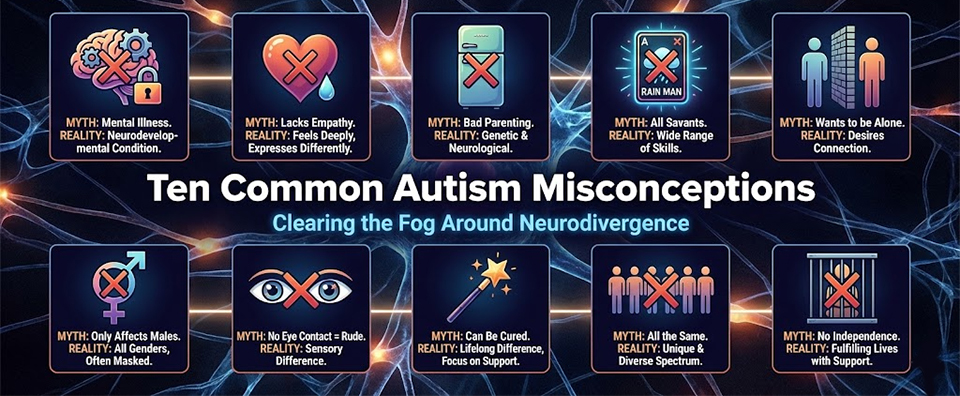
Ten Common Autism Misconception
1. Autism is a mental illness.
Reality: Autism Spectrum Disorder (ASD) is a neurodevelopmental condition, a difference in brain development and function. It is not a mental illness. While autistic individuals may experience co-occurring mental health conditions (like anxiety or depression), autism itself is not one.
2. Autistic people lack empathy or emotions.
Reality: Autistic individuals feel emotions deeply, often intensely. They may express or perceive empathy differently than neurotypical individuals, but they do experience it. Sometimes, difficulties in reading non-verbal cues can make it seem like they lack empathy, but it’s often a communication difference, not an emotional deficit.
3. Autism is caused by bad parenting (“refrigerator mothers”).
Reality: This is an outdated and harmful myth. Research overwhelmingly shows autism has genetic and neurological causes. Parenting styles do not cause autism.
4. All autistic people are savants or have special talents.
Reality: While some autistic individuals have exceptional abilities (savant skills), this is true for only a small percentage (around 10%). Like neurotypical people, autistic individuals have a wide range of skills and intellectual abilities.
5. Autistic people don’t want friends or social interaction.
Reality: Most autistic people desire social connection and friendship. They may struggle with initiating conversations, understanding social nuances, or find social situations overwhelming, leading to perceived isolation. However, the desire for connection is often very strong.
6. Autism only affects males.
Reality: Autism affects all genders. However, it is often underdiagnosed or misdiagnosed in females because their symptoms may present differently (e.g., “masking” or having more internalized struggles) and diagnostic criteria were historically based on male presentations.
7. Autistic people can’t make eye contact because they are rude or shifty.
Reality: For many autistic individuals, eye contact can be physically uncomfortable, overwhelming, or distracting, making it difficult to process information simultaneously. It’s a sensory or processing difference, not a sign of rudeness or dishonesty.
8. Autism can be cured.
Reality: Autism is a lifelong neurological difference. There is no “cure” for autism, nor is one typically desired by the autistic community. Support and therapies focus on developing skills, managing challenges, and improving quality of life, not on changing who a person fundamentally is.
9. All autistic people are the same / If you’ve met one autistic person, you’ve met one autistic person.
Reality: This is perhaps the most crucial point. Autism is a spectrum, meaning it presents differently in every individual. Strengths, challenges, and support needs vary widely.
10. Autistic people can’t live independent lives.
Reality: With appropriate support, accommodations, and understanding, many autistic individuals live fulfilling, independent, and successful lives, contributing significantly to society.