The Big Three: Neurodiverse vs. Neurodivergent vs. Neurotypical
If you spend five minutes on TikTok or read a corporate “Inclusion and Diversity” email, you’ll likely see these three words used interchangeably. But they aren’t synonyms. Words have power, and using them correctly isn’t just about grammar—it’s about respect and clarity.
Here is the no-nonsense guide to who is what, and why it matters.
1. Neurotypical (The “Standard” OS)
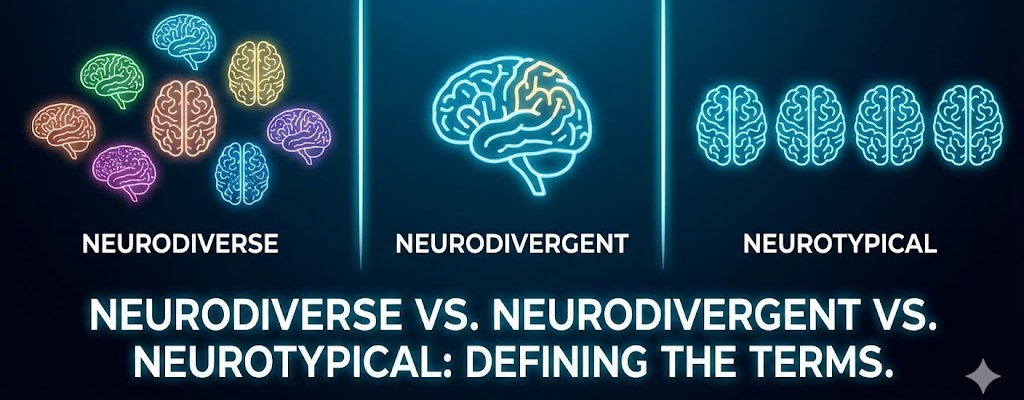
Definition: A person is neurotypical if their brain functions in the way society considers “standard” or “normal.”
Being neurotypical doesn’t mean you are “normal” in a superior way; it just means your brain behaves in the way the majority of schools, workplaces, and social norms were built to accommodate. You likely don’t have to fight your brain to process sensory input, sit still in a meeting, or understand implied social cues.
- Compassionate Note: “Neurotypical” is not an insult. It is simply a description of the dominant neurology. We need neurotypical allies in the Spectrum Threadz community just as much as we need everyone else.
2. Neurodivergent (The Individual)
Definition: A person is neurodivergent if their brain diverges (moves away) from that dominant standard.
This is the term you use for a single person. You are neurodivergent. Your child is neurodivergent.
This serves as an umbrella term for Autistic people, ADHDers, Dyslexics, and others with different cognitive processing. If you are wearing one of our “Neuro Spicy” tees, you are likely identifying as a neurodivergent individual.
- Common Mistake: “I am neurodiverse.”
- Correction: “I am neurodivergent.” (You cannot be “diverse” by yourself; diversity requires a group.)
3. Neurodiverse (The Context)
Definition: Neurodiversity describes a group of people where there is a variation in brain types.
Think of it like a forest. You wouldn’t point to a single pine tree and say, “That tree is diverse.” You would look at the forest—filled with oaks, pines, birches, and maples—and say, “This forest is diverse.”
- Correct Usage: “Our workplace is neurodiverse” (because it contains both neurotypical and neurodivergent people).
- Correct Usage: “Spectrum Threadz serves the neurodiverse community.”
Why the Distinction Matters
When we misuse these words, we accidentally erase the goal of the movement.
If we label a single person “neurodiverse,” we are often using it as a polite euphemism because we are scared to say “Autistic” or “ADHD” or “Disabled.” Directness is a form of kindness. By using the correct word—neurodivergent—we stop hiding behind vague language and start owning our identities.
Summary Cheat Sheet:
- Neurotypical: Matches the majority.
- Neurodivergent: Diverges from the majority (An individual).
- Neurodiverse: A mix of all brain types (A group).
We are all part of a neurodiverse world. The goal isn’t to separate us into camps, but to recognize that the shirt doesn’t fit everyone the same way—literally and metaphorically. That’s why we create options that work for the divergency, not against it.